Unpacking and Disassembling Dave 2
So in the last post we got stuck looking at an executable full of garbled strings. In this post I’ll walk through how I got past that hurdle and began disassembling the executable. ##
Our first Rosetta Stone [1]
So while searching through these strings, one string in particular stood out:
44 61 6e 67 2a 6f 75 73
D  a  n  g  *  o  u  s
Given the game title, this looked like it should encode the string "Dangerous", but how could a single byte represent the string "er" when all other surrounding bytes are regular ASCII?
This was a strong clue that some sort of compression was involved.
Self extracting executables
A bit more research revealed that it was common in this era to ship self-extracting executables, presumably because shipping on physical media was so constrained.
Taking another look in the hex editor, I spotted the string LZ91 at offset
0x1c within the MZ header. This gave me a lead that quickly led to
documentation on the LZEXE
utility, and its inverse,
UNLZEXE.
So armed with a 16-bit version of UNLZEXE I fired up DOSBox and ran it over
DAVE.EXE. Lo and behold, our executable now has strings:
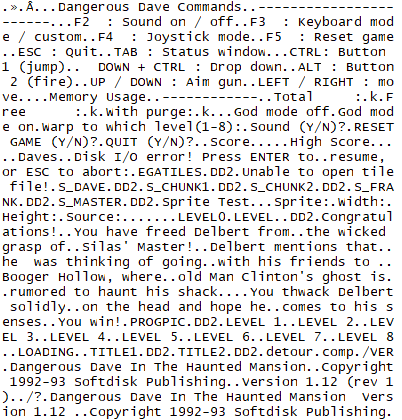
This was my first real win on this project, and it no longer seemed like purely an academic exercise. I avoided getting side-tracked here into the details of specifically how this extraction worked in practice, and decided to proceed under the assumption that we could get to work reverse engineering the output executable.
Decompilation
So strings are one thing, but it was time to bring some new tooling to the table and step into the world of decompilation.
I selected Ghidra first, mostly because it seemed fully featured, well supported and able to decompile 16-bit MS-DOS executables.
I wasn't sure what to expect. There would be no symbols and very little structure. I’d dabbled enough with emulation and remembered enough computing theory to follow assembly, but I didn’t yet have a clear plan. At this stage I was still stumbling around, unsure what was realistically achievable.
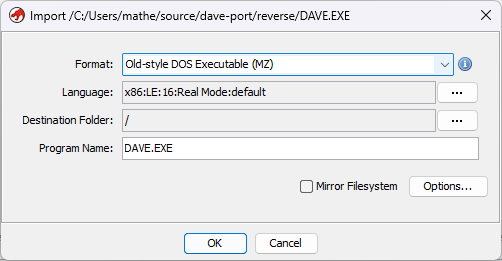
Importing the unpacked executable is daunting, but gave me a lot more confidence that I was on the right track. Immediately I could see several hundred functions, each named purely by its address in memory.
For a DOS game written by a small team in a couple of months, a few hundred functions seemed plausible. Even then, scanning the disassembly suggested there were large regions that might yet contain additional functions.
I am definitely no expert in either MS-DOS programming nor Ghidra, so take any content from here on forward as an exploration of these topics. I'll do my best to link to better sources where possible.
If you have any corrections or additional detail, I'd love to hear from you!
Ghidra immediately detected a 16-bit MS-DOS MZ executable[2]. It also marked something called Real Mode, which relates to the 16-bit segmented addressing model used by MS-DOS.
And once it's done an import, and an initial analysis with default settings, we get left with a screen full of assembly, some very obfuscated looking C decompilation window, and 373 functions.
Above the first instruction, Ghidra is indicating some assumptions around what appear to be registers.
//
// CODE_0
// ram:1000:0000-ram:1000:d98f
//
**************************************************************
*                          FUNCTION                          *
**************************************************************
undefined __stdcall16near entry(void)
  assume CS = 0x1000
  assume DS = 0x3713
  assume SP = 0x80
  assume SS = 0x448c

entry                      XREF[1]:     Entry Point(*)
    MOV        DX,0x3713
Immediately I notice the memory addresses, 1000:0000 is the location of the
first instruction and a bit of research shows that this is a segmented memory
address, with the
segment 0x1000 and an offset of 0x0000.
My first instinct here is to try and understand a little bit about how MS-DOS
would execute this file. I guess that Ghidra was mapping the executable into a
synthetic memory layout for analysis and appeared to choose 0x1000 as an
arbitrary base for mapping the load image into memory. This isn’t a DOS
requirement — it’s simply a convenient paragraph-aligned segment used for
analysis.
My next instinct was to understand a little more about Ghidra. Fortunately they provide some pretty nice educational content in their repository. Their Introduction to Ghidra class was particularly useful for getting started understanding the suite of features on offer.
Labels and Types
Being able to assign labels and types immediately stood out as features I could begin using to get a foothold in the codebase.
I quickly discovered that the decompiled C is not the source of truth — it’s Ghidra’s best attempt to express the underlying assembly in a higher-level form. I had assumed that generally there would be more lines of assembly than C, and while this is usually true, it's also true that seemingly simple sets of instructions can map to multiple lines of C code.
Ghidra provides a lot of tooling for labelling and annotating different parts of the application. It also supports being able to type memory blocks with both C primitives, but also defined structs. Ghidra does surprisingly well at inferring the size and structure of memory regions in use, and once you can correctly assign types to memory and registers, the decompilation can get quite close to something you could compile.
One Battle After Another
With Ghidra now up and running, and the basics of the codebase seemingly mapped out it was time to start forming a game plan, and it probably looked something like this:
- Explore the executable, labelling and typing anything we can so that we can start to understand the program logic and flow.
- As we begin understanding different subsystems, we start building modern reimplementations — probably assets first, then graphics, sound, input, etc.
- Locate the main game loops and start structuring our application to replicate.
- Understand gameplay systems and start reimplementing those — player movement, entity management, collision.
- Continue repeating these steps until we have a working reimplementation and have exhausted or documented all the code paths.
At this point I still don’t have a good understanding of the scope of this work, or how long it will take. But each session I spend tracing through the assembly and understanding what I'm looking at, I make a little more progress.
I've started a codebase here where I'm beginning to implement the above. From here on out the articles will probably be focussed on specific subsystems that I discover, how I traced them, and how I plan to implement them.
Next up, I’ll start tracing the game’s asset loading routines and begin writing our own loader.